
By Staff Writers / 2 February 2026

Source: IMDB/Image Supplied
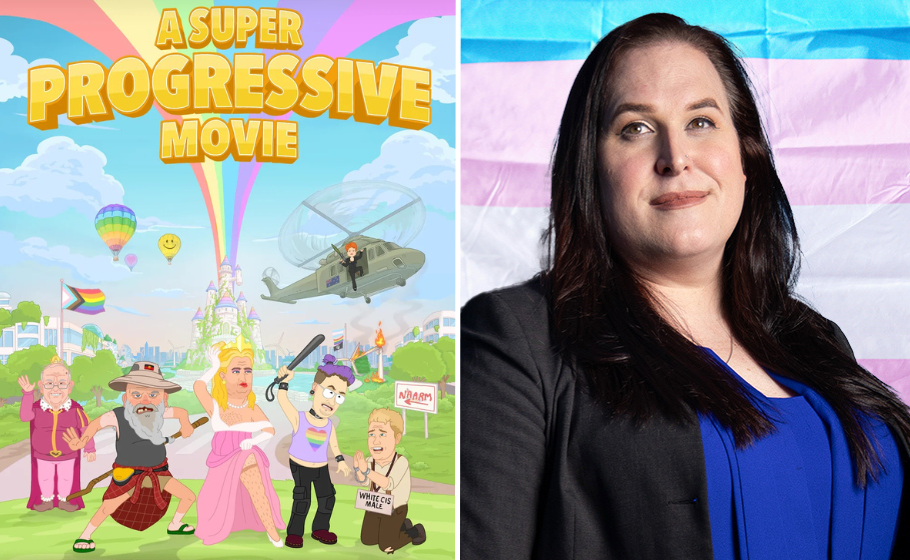
Offensive or all for laughs? Proud trans woman Michelle Sheppard watched Pauline Hanson’s A Super Progressive Movie so you don’t have to.
Written by Michelle Sheppard
I can take a joke. I’ve always been able to.
I grew up on comedies where nothing was sacred, and everything was fair game. Messy. Offensive. Sometimes genuinely awful.
And still, somehow, funny. Films like Blazing Saddles, where the shock wasn’t the point so much as who the shock was aimed at.
Or Tropic Thunder, which only works because it knows exactly what it’s doing.
The joke isn’t about ‘look how edgy this is.’ The joke is arrogance. Entitlement. Hollywood is disappearing up its own ass.
You’re not laughing because it’s crude. You’re laughing because it’s pointing at something bigger than the characters on screen and saying, look at this mess.
I also laughed at much clumsier things.
In Bachelor Party, a gender diverse sex worker walks into a bathroom and urinates standing up.
I laughed back then, not because it was kind or enlightened, but because that was the language of comedy at the time. Crude. Clumsy. Unfiltered.
Context matters. Intent matters. And so does what the joke is actually doing, even if you don’t have the words for it yet.
The difference between humour that challenges and humour that bullies
Culturally, I didn’t grow up marinating in queer anthems and pop divas.
I wasn’t blasting Kylie. I was listening to Van Halen and Toby Keith. Honestly, I still do.
I came up in a world of pub humour, blokey country music, thick skin, and the unspoken rule that if you wanted to survive, you learned how to laugh first.
That background matters.
It shaped what I found funny, what I tolerated, and how long it took me to realise when something wasn’t actually humour at all.
I’ve also listened, really listened, when Dave Chappelle talked about his transgender friend.
About laughing with her, not at her. About intimacy, trust, and shared humour across difference.
I didn’t agree with all of it, but I could sit with it, think about it and hold the discomfort without shutting down.
And yes, I know that by this point, I’ve probably already lost a chunk of readers.
Mention Bachelor Party and Dave Chappelle in the same breath, and some people will close the tab, mutter ‘yikes’, and move on. That’s fine.
This isn’t about performing ideological purity or presenting a flawless moral record. It’s about honesty.
About being able to say: I’ve laughed at shit that I wouldn’t laugh at now. I’ve sat with arguments I didn’t fully agree with. I’ve changed and grown.
That doesn’t make me weak or inconsistent. It makes me experienced.
‘Comedy isn’t measured by who you upset’
And that experience is exactly why I can tell the difference between humour that challenges you and humour that just bullies with better lighting.
I don’t come to this stuff fragile or closed off. I come to it practised.
When you’re transgender, you don’t get the luxury of a perfectly affirming media diet. You learn to filter.
You learn to read comment sections on purpose, to scroll past being called fat, ugly, delusional, or worse, and still get on with your day.
To sit with discomfort and to watch things that sting without collapsing.
So, when people assume I’m offended by default, they’re wrong. I can take a joke. But I can also tell when someone is trying to be funny and doing just the opposite.
That’s the problem with A Super Progressive Movie. It wants credit for being brave. It wants applause for saying what you’re not allowed to say anymore.
But bravery in comedy isn’t measured by who you upset. It’s measured by what you reveal. About power, about hypocrisy, about yourself.
This film reveals none of that.
Never interrogating its own side or implicating its audience. It never turns the camera inward.
It just hands you straw-man caricatures of ‘progressive’ and waits for recognition.
‘You know these people. Aren’t they awful?’ it says, followed by how progressive they really are at the end of the movie, and by a man who is ‘1/16th Aboriginal’, so it must be true.
That isn’t satire, it’s a grievance with punchlines taped on
The trans woman in the film isn’t really written as a character. She feels assembled.
Built out of things the creators know will sting.
A deliberately deep, mocking voice. A heavy five o’clock shadow you’re not allowed to miss. Lipstick smeared just enough to read as sloppy, not expressive.
Body hair is exaggerated and placed exactly where your eye keeps getting dragged back to it.
Her face swings between forced cheer and sudden aggression, never neutral, never allowed to just be.
And I’ll be honest; I laughed at first. Not proudly.
More than a reflexive, shocked little chuckle you do when something comes out of nowhere as you verbally say, ‘What the f**k?!’, and your brain hasn’t caught up yet.
Then it hit. That cold drop in the stomach. That quiet thought: ‘Is this how people see me?’ I felt gross and embarrassed by this caricature.
Because none of this is accidental. These aren’t sloppy choices. They’re telling.
Visual cues are carefully stacked so the audience knows exactly when to laugh and what they’re laughing at.
The joke isn’t hypocrisy. It’s not behaviour. It’s not power. The joke is the body itself. And that’s where it stops being clever and starts hurting.

Being transgender isn’t a debating tactic
For trans women, those details aren’t theoretical. They’re about survival.
Voice. 5 o’clock Shadow. Hair. Makeup. Every one of them is something we learn to monitor, soften, hide, or overcorrect just to move through the world without being stared at, mocked, challenged, or worse.
Those same traits get used in real life to deny service, question legitimacy, laugh people out of rooms, or justify cruelty that goes far beyond a joke.
I know the difference in how I’m treated when I am wearing a footy hoodie and chinos and a ponytail versus a dress and a full face of makeup.
Often, the same way in and out of the LGBTIQA+ community. It’s shit, but I sit with a smile often and let it wash over like water off a duck’s back.
The film keeps circling back to this sneering idea of ‘Victim Hood’. In this worldview, marginalised people aren’t responding to real conditions.
They’re wrapped in grievance like a cloak. Hiding inside it. Milking it. Rewarded for wearing it loudly enough.
It’s played with a wink, as if we’re all meant to nod along and agree that oppression is mostly just a performance now.
A bit of theatre. A bad habit people refuse to grow out of. That it is all in our heads.
What it never stops to consider is that for many of us, there is no costume to take off at the end of the day. No hood to hang up by the door.
Being transgender, Aboriginal, queer, this isn’t a rhetorical posture or a debating tactic.
It’s a lived condition shaped by law, policy, safety, healthcare access, how police treat you, how strangers read you, and whether the world decides you’re credible or expendable in any given moment.

Who is the real victim here?
The cruelty of the ‘Victim Hood’ framing is that it turns lived reality into a competition.
Who’s really oppressed? Who has it worse? Who’s allowed to speak? Who should shut up because someone else has it tougher?
It fuels lateral violence, where people already under pressure are pushed to turn on each other instead of looking up at the systems doing the squeezing.
Suddenly, it’s not about changing conditions; it’s about ranking pain. The oppression Olympics, complete with scorecards and sneers.
And that’s convenient.
Because when marginalised people are busy arguing amongst themselves, comparing scars, policing each other’s legitimacy, the people with the most power get to stand back and say, ‘See? Even they can’t agree.’
Calling all of this ‘victimhood’ is a neat trick. It flattens consequence into attitude. It reframes structural harm as personal weakness.
And it lets responsibility quietly slip out the side door, while pretending the real problem is people asking not to be crushed in the first place.
I understand rivalry; I come from a place that runs on it.
I grew up with St. Louis versus Chicago baked into the air you breathe. Cardinals versus Cubs. You do not wear a Cubs hat in St. Louis. Ever. And vice versa.
That rivalry is tribal, emotional, and loud.
But even in the middle of that, there were lines. In the late ’90s, during the home run race, when something genuinely historic was unfolding, people clapped for the other team.
Not because they’d switched sides, but because respect still mattered. You could hate the jersey and still recognise the moment.
I see the same thing with Melbourne versus Sydney
The bagging is constant, and most of the time it’s affectionate. It’s banter, it’s culture, part of how Australians relate to each other.
But what this film does with Melbourne, with Naarm, isn’t banter. It isn’t rivalry. It’s scapegoating.
The city is framed as if it’s the source of everything wrong with society. As if progress, diversity, queerness, and social change are some kind of contagion that started there and needs to be stamped out.
As an expat, that hit harder than I expected.
I didn’t just move to Melbourne; I fell in love with it. I fell in love with how it thinks, how it argues, how it makes space for people who don’t quite fit elsewhere.
It’s messy and imperfect and loud and deeply human.
Painting Naarm as a moral disease, rather than a city grappling openly with change, isn’t satire. It’s lazy.
It turns complexity into blame and culture into a punching bag. Rivalry can be playful. This wasn’t.
This was contempt, dressed up as humour, aimed at a place that dares to try. It’s not doing hard work; it’s taking the easy way out.
It’s also telling that Pauline Hanson casts herself as Prime Minister, not ironically, but reverently.
The posture is commanding. Corrective. Almost paternal.
It mirrors that Trumpian fantasy of restoration through dominance, where confidence is mistaken for competence and dissent is framed as betrayal. This isn’t parodying ambition. It’s cosplay for grievance politics.
And the violence makes that unmistakable. Anthony Albanese is depicted physically striking Penny Wong.
A woman of colour is humiliated through gendered aggression, then deliberately voiced by a man to heighten the degradation.
Moments later, Albanese raises his arm in a Sieg Heil salute. This isn’t a critique. It’s an escalation.

‘This film doesn’t want reflection; it wants validation’
Disagreement collapses into violence. Enemies aren’t debated. They’re punished.
After watching the film, I saw online commentary fixating on the animal violence, with people shocked and upset by those moments.
And sure, I noticed them. But what stayed with me wasn’t the harm done to animals. It was the ease with which violence against people was normalised, stylised, and cheered on.
The casual way political opponents, women, and marginalised figures are struck, degraded, or erased, played for laughs or righteousness.
That’s what landed hardest. Not the spectacle of cruelty, but who it was directed at, and how comfortable the film seemed casual about it.
People keep comparing this to Blazing Saddles or South Park, and that comparison doesn’t hold. Blazing Saddles made racists look ridiculous. South Park mocks everyone, including itself.
Both understand that satire without self-awareness is just noise. This film doesn’t want reflection; it wants validation.
How do you validate a moment where the white lead darkens his skin to pass as ‘Aboriginal’ so he can access Uluru, followed by a crude petrol joke and then blowing the place up?
Blackface, desecration, and destruction played as a gag. Not satire. Just disrespect stacked on top of itself and again called “brave”.
When I watch this as a trans woman, it stops being provocative and becomes dangerous.

‘Nothing here is accidental’
Content like this doesn’t just offend. It primes. It feeds narratives that justify harassment, exclusion, and violence.
I don’t get to switch that off when the credits roll. I carry it into train stations, public toilets, workplaces, and bars.
Into every moment where someone decides whether I’m human or a threat.
Satire that ignores that context isn’t brave. It’s reckless with other people’s lives.
And for everyone insisting ‘you can’t laugh anymore’, here’s the truth. You can still laugh. You just can’t expect silence anymore.
Pushback isn’t censorship. Being challenged isn’t oppression. The audience has simply grown a voice. For some people, that feels like a loss.
This film isn’t unfunny because it’s risky. It’s unfunny because it’s stuck.
Nostalgic for a time when jokes landed without consequence and resentful that the world moved on.
Comedy evolves, or it dies.
I watched this movie twice. Open. Guarded. Willing to be surprised. I wasn’t.
It isn’t brave, clever or dangerous. It’s just tired. A tantrum animated in bright colours, mistaking volume for insight.
By the time the credits roll, and the boilerplate disclaimer claims everything is ‘purely coincidental’, the lie is complete.
Nothing here is accidental. The contempt is deliberate. The targets are chosen.
I found myself saying ‘no’ out loud. Then ‘oh no’, then finally, ‘this is f**ked’. Not because I couldn’t take a joke.
But because this isn’t one.

For the latest LGBTIQA+ Sister Girl and Brother Boy news, entertainment, and community stories in Australia, visit qnews.com.au. Find us on Facebook, Twitter, Instagram and YouTube.

Get the best of what’s queer.Email SUBSCRIBE
Originally posted: https://qnews.com.au/i-can-take-a-joke-this-just-isnt-one-a-super-progressive-movie/ 2 February 2026

Leave a Reply